Attending the 2026 Association of Tribal Archives, Libraries, and Museums (ATALM) Conference on behalf of WiLS and the Culture Keepers Collective in Spokane, Washington was, as always, both professionally and personally meaningful. I attended once before as a student in 2019, so this was my first time as a WiLS staff member. What strikes me every year is how directly relevant the conference is to our work and how deeply the work matters. It is not only about preserving Indigenous culture; it is about bringing that culture forward into living, breathing work for today and for the future.
The conference opened with an evening cultural welcome that set the tone by including everyone present in an intertribal round dance. It was a warm reminder that ATALM is first and foremost a community, and there is something deeply human about hundreds of people dancing in a giant circle together. Much of the evening was conducted first in Interior Salish, the Spokane Tribe of Indians’ native language, and sessions throughout the conference opened the same way, with introductions presented first in Indigenous languages.
The sessions focused on sovereignty and self-determination. We explored the risks that cloud technology and AI pose to Tribal knowledge sovereignty and how MOU and MOA frameworks can protect Indigenous data and build relational accountability – the practice of holding oneself responsible to the people, communities, and relationships involved in the work, rather than just institutional priorities. One takeaway was that work with Indigenous collections should begin with an agreement rather than a deed of gift: establish the relationship before asking who is giving what and in what direction. I attended a listening session on Indigenizing Archival Training, which will offer free workshops for Tribal archivists starting in 2027. Smaller sessions, including one on the oral histories of contemporary Pueblo women and another on the digitization of more than 2,500 cultural objects at the Lānaʻi Culture & Heritage Center, showed the same commitment to community-led work at every scale.
I had the honor of presenting Advancing Digital Readiness: A Guide to Creating and Tending Digital Collections with Selena Ortega-Chiolero, Museum Specialist at the Chickaloon Village Traditional Council, and Shay Hix, founding member of the Community Archiving Workshop (CAW) Collective. We shared the free Digital Readiness Toolkit and our partnership with CAW to expand it for audiovisual collections. Selena walked through Chickaloon’s experience using the Toolkit as they bring Ahtna knowledge home. The Ahtna are an Alaska Native Athabascan (Dene) people of south-central Alaska, and Ahtna is also the name of their language. For Chickaloon, bringing knowledge home means returning Ahtna language, stories, and cultural materials held in outside archives to the community. Their work included using a more consistent file naming approach, a takedown process, a statement on potentially harmful content, a physical inventory of their analog audiovisual collection, and an Ahtna subject headings list. Their advice was to start with an inventory rather than a scanner, because technology was not the greatest obstacle; capacity was.
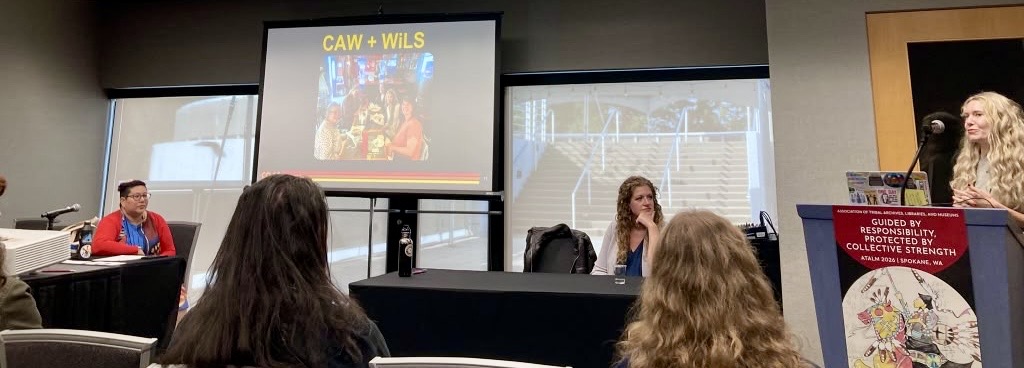
Some of the best moments were the in-between ones, catching up with friends and colleagues, including our CAW collaborators. That is part of what makes ATALM what it is: this work is built on relationships, responsibility, and community leadership. I am grateful to WiLS for the opportunity to be part of it, but more so to the Tribal Nations and cultural workers who share so generously.